Bösendorfer piano
The Glass RoomThe Bösendorfer piano is the surviving instrument of the Landauer family’s Glass Room and a recurring point of contact between the house’s intimate past and its wartime occupation. As officials turn the home into a biometric research centre, its sound and familiar presence resist the new order’s claim that the building can be remade without remainder. It carries memories of music and family life, but also gives voice to grief that the machinery of racial classification cannot contain.
From household furnishing to conspicuous remnant
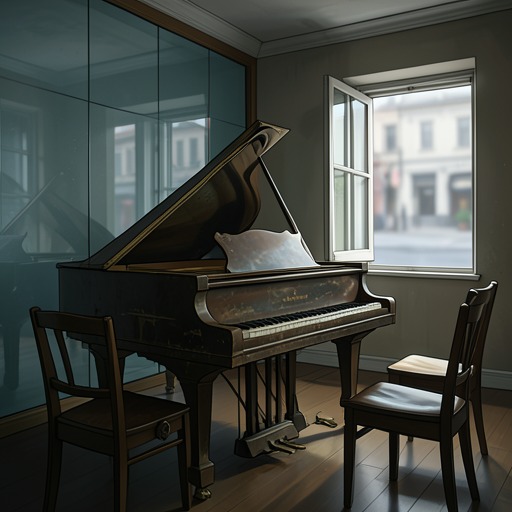
When a surveyor inspects the Glass Room, he finds its open-plan design elegant but impractical and wonders where the specially designed furniture has gone. The piano is among the few objects that still registers as part of the room’s former life: the surveyor lifts its lid and plays a single note, which dies away in the chrome-and-glass expanse. The small action makes the altered space audible. The room that once gathered furnishings and people now gives the note nowhere to settle.
Later, another visitor asks where an object in the house came from and is told that it supposedly came from Africa, though the answer is uncertain. The conversation turns to the piano, which stands in the shadow of the onyx partition. The visitor identifies it as a Bösendorfer, asks who played, then tries several notes with a practised ear and concludes that it needs tuning. The replies establish that Mrs Landauer played a little and that the family sometimes held public charity recitals. The instrument therefore points beyond private domestic use: it belonged to a house whose occupants also opened music-making to an audience and charitable purpose.
The piano inside the research centre
Under the occupation, the house is refitted for research. Upstairs rooms become offices, the kitchens are converted into a laboratory, and a basement room is prepared for an X-ray machine. The Glass Room, too, is reorganized: curtains divide it into sections, anthropometric equipment is set before the onyx wall, and the dining area becomes a photographic studio. Scales, a height-measuring stand, a steel-ruler device, callipers, lights, and a Rolleiflex camera give the former living space the appearance of a laboratory devoted to examining and classifying bodies.
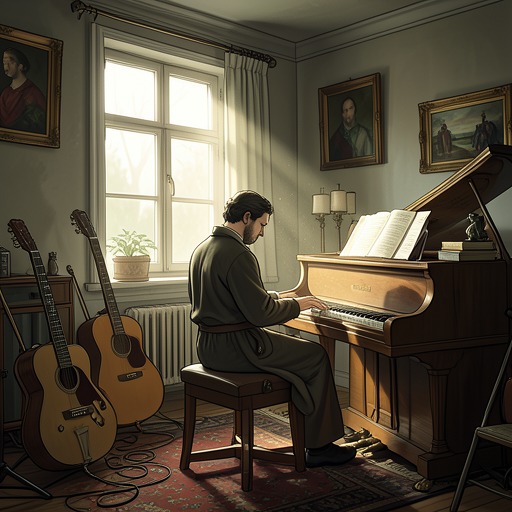
The piano remains amid this conversion. Its survival is not simply neglect: Stahl arranges for a Jewish piano tuner to restore its perfect tones. The contrast is sharp. Around the instrument, officials install equipment and documentation systems for the centre’s vast project of cataloguing human variation; the piano retains a use irreducible to those systems, requiring a player and a listener rather than a form or measurement. Yet its continued presence does not make the room safe or preserve its former life. It is kept in tune inside a house that has been appropriated and repurposed.
A discordant recognition
When a woman visits the transformed measuring room, she observes that the only thing Liesel Landauer would recognize is the piano. She calls it the only thing in place and asks whether it is there merely for show or whether anyone plays it. The officer answers that before feeling the call of science he studied at the Munich conservatory and still tries to keep his hand in. This exchange gives the piano an uneasy double role: it is a remnant recognizable to the former owner, but it also belongs to the daily world of the occupying institution and its personnel.
The woman asks the officer to play for her sometime. Later, in the library area, the red-gold light gathering inside the onyx wall makes the stone seem to burn. She recalls that this effect was never planned and had surprised the household the first time it appeared. Against this accidental spectacle, she returns to the piano and reminds the officer of his promise. She challenges him to play as if alone, as though war, occupation, and deportations could be set aside for a moment. The instrument becomes the means by which she names the violence he would prefer to bracket, even while asking him to imagine a time without fear.
Music as memory and measure
The officer finally sits down and plays a piece he used to play with Hedda. The performance is quiet and hesitant; the notes move through the Glass Room as the red light in the onyx fades. He hears the absent violin part as he plays, sensing it like a bereaved twin’s missing sibling. The piano does not restore the lost musical partnership, but it makes absence perceptible. In a room redesigned to render bodies measurable, the music gives form to a loss that cannot be entered on a chart.
The instrument also enters a later account of Erika’s illness. Her father describes her as a beautiful, apparently perfect baby who smiled, recognized her parents, and reached for them in her cot. He compares the first signs of her decline to a piano going out of tune: first she could no longer smile, then she stopped looking at her parents, and eventually she could not grasp her rattles and toys. To make the comparison concrete, he lifts the piano lid and presses a combination of keys; a clear C-sharp-minor chord sounds through the Glass Room. The exact correspondence between keys and chord contrasts with the irreversible loss he describes. Here the piano supplies a vocabulary for change: a once-harmonious life can go out of tune, while the instrument itself still sounds the notes set for it.
Meaning across the altered house
The Bösendorfer links several versions of the same room without erasing their differences. It recalls the Landauers’ domestic life and their public charity recitals; it remains conspicuous when the house becomes a research centre; and it helps carry memories of both bereavement and family illness. Its changing context is central to its force. First heard as a lone note vanishing in an emptied space, it is later restored to full tone, played to summon a lost duet, and used to give precise musical shape to a child’s deterioration.
The piano’s continued presence is not proof that the house’s earlier world survives intact. The furniture is gone, the Glass Room has been partitioned and equipped for bodily measurement, and the instrument itself requires a tuner after the transformation. Instead, its persistence exposes the limits of the new order’s remaking of the house. A piano can be appropriated, maintained, and made to sound inside the research centre, but its associations exceed the centre’s purpose: it recalls former inhabitants, public gatherings, shared music, and private grief. In that tension, the Bösendorfer becomes both a material remnant and a measure of what the occupation cannot make wholly disappear.